Your customers are asking AI assistants to recommend businesses like yours right now. ChatGPT for the best dentist. Perplexity for a structural engineer. Google AI Overviews for a wedding photographer.
The AI gives an answer. It names two or three businesses. If yours isn't one of them, you don't get a second chance — the customer doesn't scroll. They book the one the AI mentioned.
And here's what most tools miss: the inputs are the same work as SEO. Google's own guidance, published 15 May 2026, states explicitly that optimizing for AI search is optimizing for SEO. Technical health, structured data, authority signals — shared fundamentals. But the places diverge, the measurements diverge, and so do the failure modes. Ranking is a different problem from being cited. Citation is a different problem from entity clarity. One underlying discipline. Three distinct scorecards — because a single combined score hides exactly where you're weak.
Google's own guidance says it: optimizing for AI search is optimizing for SEO. We measure your visibility across all three places where your customers find you — and we fix the issues that hold you back on each.
On-page signals, Core Web Vitals, mobile readiness, schema completeness, and the keyword patterns that drive commercial intent queries. The work most tools have always done — we do it continuously, automatically, not just when you remember to publish a post.
When Google generates an AI Overview for a query in your category, does it cite you? This requires structured Q&A content, FAQ schema, and machine-readable entity signals — not just keyword density. We check real Perplexity and Google AI response data.
AI assistants extract attributable facts: third-party citations, distributed review signals, machine-readable trust evidence, and specific claims over superlatives. A page that says "trusted by leading businesses" gives the model nothing to cite. We tell you what's missing and draft the content that fills it.
Each place has different signals and different competitors. The work overlaps. The reporting doesn't.
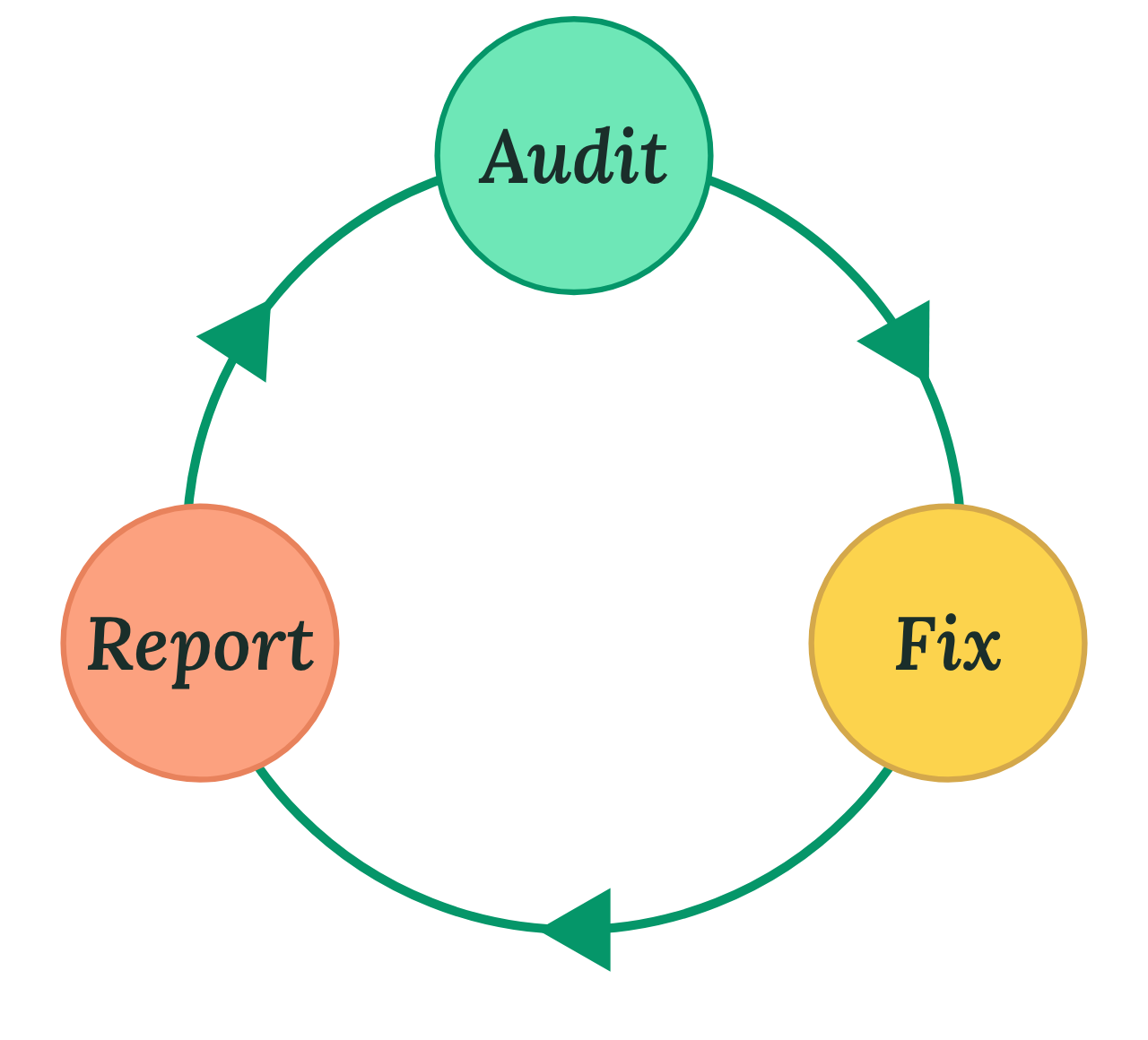
Most SEO platforms give you a dashboard, a checklist, and a goodbye. Our auto-fix loop closes the gap between knowing and doing.
When we find an opportunity, we draft a fix. You review it. Nothing ships without your approval. Approved fixes deploy automatically where possible; where they can't, we hand you the fix with instructions on where / how to implement.
The loop restarts after each approved fix — so your scores reflect what you've actually deployed.
ChatGPT, Claude, Perplexity, and Gemini are already telling buyers what your business does, who it serves, and why they should care. Most of it comes from sources you don't control. Some of it is wrong. Some is outdated. Some quietly describes you as a competitor's second choice.
We run structured questions across every major AI assistant — what's your ICP, what are your strengths, why pick you over [competitor]? We score the answers for accuracy, ICP alignment, and source attribution. Then we fix the source material AI is reading from — meta descriptions, FAQ entries, /vs/ pages, schema corrections — and we re-check on the next cycle to verify AI's view actually shifted.
No other tool in our price range does this. Most don't do it at any price.
A crawl report with 1,247 errors isn't 1,247 opportunities. It's mostly noise. We show you the three fixes that move the needle this week — each one with the specific signal we measured to rank it — plus the ones worth scheduling later.
Everything else, we explicitly tell you to skip, and we name the reason: high effort, low uplift at your current baseline, or already handled by a connected system.
Most tools call this "comprehensive." We call it noise. The businesses we serve don't have an SEO team to filter it.
Each ranking is based on a formula: predicted impact = (2 × impact score) ÷ effort weight. Transparent, attributable, published in the FixMySEO Standard.
We don't hide behind mystical scoring or hidden SEO magic.
We publish our complete methodology. The signals we check, the formulas behind every score, and a free validator anyone can run. Aligned with Google's official guidance. No theatre.
Our Standard is an open npm package and a GitHub repository. When we add a new check or change a formula, it is public. Every score on your report can be traced to a specific signal in the Standard.
40+ measurements across 20 checks, scored and weighted. Published openly so you can audit our audit.
npx @fixmyseo/standard validateNo agency. No setup fees. No phone calls. Sign up, paste your URL, approve the first fixes within an hour.
20% discount on annual billing. Cancel anytime — no lock-in, no exit fee.
Save 20% with annual billing — Starter $63/mo · Growth $143/mo · Agency $279/mo
I built FixMySEO because I needed it for my own businesses, and nothing on the market closed the loop. Plugins were checklists. Agencies were £2,000 a month. Nothing in between took AI visibility seriously enough to actually fix things — not just report them. So I built something that did.
No account required. Paste your URL and get three scores and a ranked fix list — free.
See how it works →